 Add to Chrome
 Add to Firefox
 Add to Edge
Mechanistic Diagnostics of Spatial Lexical Bias in Multimodal Large Language Model Spatial Reasoning
Jun 01, 2026
Multimodal large language models (MLLMs) remain unreliable on spatial multiple-choice questions, and their failures are often attributed to poorly attended visual information. In this work, we identify a complementary failure mode, spatial lexical bias: adding a spatial relation word to the answer options can attract the model's decision and make the newly added option likely to be selected. Using nine open-weight MLLMs, we show that this phenomenon is widely observed. In particular, models can answer a binary spatial question correctly, yet consistently select an incorrect third spatial option once it is added to the answer set. We isolate such binary-stable but ternary-fragile cases as diagnostic examples and leverage mechanistic interpretability tools, revealing that a substantial part of the failure instead originates on the language side rather than the visual side: visual attention analyses and residual-stream probes show the correct spatial relation remains internally available on these failures, while irrelevant-option controls, activation patching, and sparse component interventions trace the bias to specific LLM-side channels and neurons. Based on this finding, we show that a lightweight LLM-only DPO update on tiny single-object-pair synthetic data mitigates the bias, lifting four-way robust accuracy by up to 100 points on synthetic data, and by 68.0, 32.6, and 20.1 points on broader evaluation datasets WhatsUp, SpatialMQA-Direct, and VSR.

Awakening the Hydra: Stabilizing Multi-Concept Backdoor Injection in Text-to-Image Diffusion Models
May 19, 2026Text-to-image diffusion models are increasingly developed through open-source reuse and repeated downstream fine-tuning, where reused checkpoints are difficult to verify and thus more susceptible to hidden backdoor behaviors. In such ecosystems, a single pretrained model may be sequentially adapted and redistributed by multiple independent parties, allowing multiple concept-specific trigger-target associations to accumulate in the same model. When these associations coexist, semantic conflicts can be amplified in the shared representation space, leading to cross-concept entanglement and degraded generation quality. Notably, instead of strengthening the attack, such accumulation can destabilize previously injected behaviors and reduce attack reliability. In this work, we systematically investigate backdoor attacks under this interference-prone setting and propose Hydra, a unified framework for robust and controlled multi-concept backdoor injection under cumulative and decentralized reuse. Our core insight is that stable backdoor injection under large-scale multi-concept settings requires explicitly constraining trigger semantics while coordinating cross-task interactions during optimization. Specifically, Hydra performs evolutionary trigger search in the text encoder space to identify triggers that are semantically aligned with their target concepts while remaining stable across other injected concepts. It further combines multi-task fine-tuning with trigger-clean regularization to improve training stability under dense multi-concept injection. Extensive experiments across multiple diffusion backbones under rigorous multi-concept settings show that Hydra maintains effective backdoor activation while preserving clean generation fidelity and image quality. For instance, across 8 attackers and 500 concept pairs, Hydra maintains ~95% ASR and strong clean generation.
AgentCE-Bench: Agent Configurable Evaluation with Scalable Horizons and Controllable Difficulty under Lightweight Environments
Apr 10, 2026Existing Agent benchmarks suffer from two critical limitations: high environment interaction overhead (up to 41\% of total evaluation time) and imbalanced task horizon and difficulty distributions that make aggregate scores unreliable. To address these issues, we propose AgentCE-Bench built around a unified grid-based planning task, where agents must fill hidden slots in a partially completed schedule subject to both local slot constraints and global constraints. Our benchmark offers fine-grained control through two orthogonal axes: \textbf{Scalable Horizons}, controlled by the number of hidden slots $H$, and \textbf{Controllable Difficulty}, governed by a decoy budget $B$ that determines the number of globally misleading decoy candidates. Crucially, all tool calls are resolved via static JSON files under a \textbf{Lightweight Environment} design, eliminating setup overhead and enabling fast, reproducible evaluation suitable for training-time validation. We first validate that $H$ and $B$ provide reliable control over task horizon and difficulty, and that AgentCE-Bench exhibits strong domain consistency and model discriminability. We then conduct comprehensive experiments across 13 models of diverse sizes and families over 6 domains, revealing significant cross-model performance variation and confirming that AgentCE-Bench provides interpretable and controllable evaluation of agent reasoning.
ACE-Bench: Agent Configurable Evaluation with Scalable Horizons and Controllable Difficulty under Lightweight Environments
Apr 07, 2026Existing Agent benchmarks suffer from two critical limitations: high environment interaction overhead (up to 41\% of total evaluation time) and imbalanced task horizon and difficulty distributions that make aggregate scores unreliable. To address these issues, we propose ACE-Bench built around a unified grid-based planning task, where agents must fill hidden slots in a partially completed schedule subject to both local slot constraints and global constraints. Our benchmark offers fine-grained control through two orthogonal axes: Scalable Horizons, controlled by the number of hidden slots $H$, and Controllable Difficulty, governed by a decoy budget $B$ that determines the number of globally misleading decoy candidates. Crucially, all tool calls are resolved via static JSON files under a Lightweight Environment design, eliminating setup overhead and enabling fast, reproducible evaluation suitable for training-time validation. We first validate that H and B provide reliable control over task horizon and difficulty, and that ACE-Bench exhibits strong domain consistency and model discriminability. We then conduct comprehensive experiments across 13 models of diverse sizes and families over 6 domains, revealing significant cross-model performance variation and confirming that ACE-Bench provides interpretable and controllable evaluation of agent reasoning.
When Domains Interact: Asymmetric and Order-Sensitive Cross-Domain Effects in Reinforcement Learning for Reasoning
Feb 01, 2026Group Relative Policy Optimization (GRPO) has become a key technique for improving reasoning abilities in large language models, yet its behavior under different domain sequencing strategies is poorly understood. In particular, the impact of sequential (one domain at a time) versus mixed-domain (multiple domain at a time) training in GRPO has not been systematically studied. We provide the first systematic analysis of training-order effects across math, science, logic, and puzzle reasoning tasks. We found (1) single-domain generalization is highly asymmetric: training on other domains improves math reasoning by approximately 25\% accuracy, while yielding negligible transfer to logic and puzzle; (2) cross-domain interactions are highly order-dependent: training in the order math$\rightarrow$science achieves 83\% / 41\% accuracy on math / science, while reversing the order to science$\rightarrow$math degrades performance to 77\% / 25\%; (3) no single strategy is universally optimal in multi-domain training: sequential training favors math (up to 84\%), mixed training favors science and logic, and poor ordering can incur large performance gaps (from 70\% to 56\%). Overall, our findings demonstrate that GRPO under multi-domain settings exhibits pronounced asymmetry, order sensitivity, and strategy dependence, highlighting the necessity of domain-aware and order-aware training design.
MMME: A Spontaneous Multi-Modal Micro-Expression Dataset Enabling Visual-Physiological Fusion
Jun 12, 2025Micro-expressions (MEs) are subtle, fleeting nonverbal cues that reveal an individual's genuine emotional state. Their analysis has attracted considerable interest due to its promising applications in fields such as healthcare, criminal investigation, and human-computer interaction. However, existing ME research is limited to single visual modality, overlooking the rich emotional information conveyed by other physiological modalities, resulting in ME recognition and spotting performance far below practical application needs. Therefore, exploring the cross-modal association mechanism between ME visual features and physiological signals (PS), and developing a multimodal fusion framework, represents a pivotal step toward advancing ME analysis. This study introduces a novel ME dataset, MMME, which, for the first time, enables synchronized collection of facial action signals (MEs), central nervous system signals (EEG), and peripheral PS (PPG, RSP, SKT, EDA, and ECG). By overcoming the constraints of existing ME corpora, MMME comprises 634 MEs, 2,841 macro-expressions (MaEs), and 2,890 trials of synchronized multimodal PS, establishing a robust foundation for investigating ME neural mechanisms and conducting multimodal fusion-based analyses. Extensive experiments validate the dataset's reliability and provide benchmarks for ME analysis, demonstrating that integrating MEs with PS significantly enhances recognition and spotting performance. To the best of our knowledge, MMME is the most comprehensive ME dataset to date in terms of modality diversity. It provides critical data support for exploring the neural mechanisms of MEs and uncovering the visual-physiological synergistic effects, driving a paradigm shift in ME research from single-modality visual analysis to multimodal fusion. The dataset will be publicly available upon acceptance of this paper.
MPFNet: A Multi-Prior Fusion Network with a Progressive Training Strategy for Micro-Expression Recognition
Jun 11, 2025Micro-expression recognition (MER), a critical subfield of affective computing, presents greater challenges than macro-expression recognition due to its brief duration and low intensity. While incorporating prior knowledge has been shown to enhance MER performance, existing methods predominantly rely on simplistic, singular sources of prior knowledge, failing to fully exploit multi-source information. This paper introduces the Multi-Prior Fusion Network (MPFNet), leveraging a progressive training strategy to optimize MER tasks. We propose two complementary encoders: the Generic Feature Encoder (GFE) and the Advanced Feature Encoder (AFE), both based on Inflated 3D ConvNets (I3D) with Coordinate Attention (CA) mechanisms, to improve the model's ability to capture spatiotemporal and channel-specific features. Inspired by developmental psychology, we present two variants of MPFNet--MPFNet-P and MPFNet-C--corresponding to two fundamental modes of infant cognitive development: parallel and hierarchical processing. These variants enable the evaluation of different strategies for integrating prior knowledge. Extensive experiments demonstrate that MPFNet significantly improves MER accuracy while maintaining balanced performance across categories, achieving accuracies of 0.811, 0.924, and 0.857 on the SMIC, CASME II, and SAMM datasets, respectively. To the best of our knowledge, our approach achieves state-of-the-art performance on the SMIC and SAMM datasets.
Neural Collapse in Cumulative Link Models for Ordinal Regression: An Analysis with Unconstrained Feature Model
Jun 06, 2025A phenomenon known as ''Neural Collapse (NC)'' in deep classification tasks, in which the penultimate-layer features and the final classifiers exhibit an extremely simple geometric structure, has recently attracted considerable attention, with the expectation that it can deepen our understanding of how deep neural networks behave. The Unconstrained Feature Model (UFM) has been proposed to explain NC theoretically, and there emerges a growing body of work that extends NC to tasks other than classification and leverages it for practical applications. In this study, we investigate whether a similar phenomenon arises in deep Ordinal Regression (OR) tasks, via combining the cumulative link model for OR and UFM. We show that a phenomenon we call Ordinal Neural Collapse (ONC) indeed emerges and is characterized by the following three properties: (ONC1) all optimal features in the same class collapse to their within-class mean when regularization is applied; (ONC2) these class means align with the classifier, meaning that they collapse onto a one-dimensional subspace; (ONC3) the optimal latent variables (corresponding to logits or preactivations in classification tasks) are aligned according to the class order, and in particular, in the zero-regularization limit, a highly local and simple geometric relationship emerges between the latent variables and the threshold values. We prove these properties analytically within the UFM framework with fixed threshold values and corroborate them empirically across a variety of datasets. We also discuss how these insights can be leveraged in OR, highlighting the use of fixed thresholds.
Unsupervised Domain Adaptation Through Transferring both the Source-Knowledge and Target-Relatedness Simultaneously
Mar 24, 2020

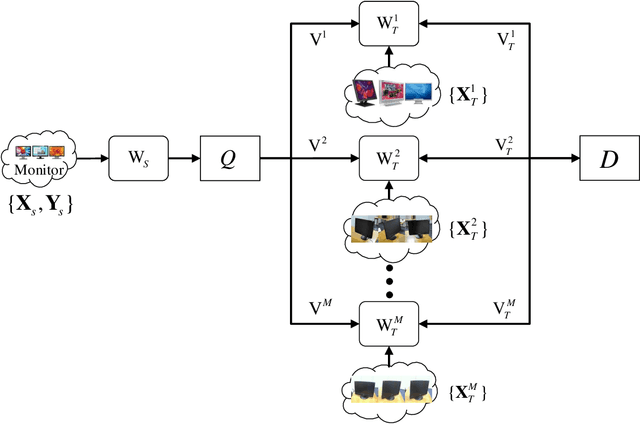

Unsupervised domain adaptation (UDA) is an emerging research topic in the field of machine learning and pattern recognition, which aims to help the learning of unlabeled target domain by transferring knowledge from the source domain. To perform UDA, a variety of methods have been proposed, most of which concentrate on the scenario of single source and single target domain (1S1T). However, in real applications, usually single source domain with multiple target domains are involved (1SmT), which cannot be handled directly by those 1S1T models. Unfortunately, although a few related works on 1SmT UDA have been proposed, nearly none of them model the source domain knowledge and leverage the target-relatedness jointly. To overcome these shortcomings, we herein propose a more general 1SmT UDA model through transferring both the Source-Knowledge and Target-Relatedness, UDA-SKTR for short. In this way, not only the supervision knowledge from the source domain, but also the potential relatedness among the target domains are simultaneously modeled for exploitation in the process of 1SmT UDA. In addition, we construct an alternating optimization algorithm to solve the variables of the proposed model with convergence guarantee. Finally, through extensive experiments on both benchmark and real datasets, we validate the effectiveness and superiority of the proposed method.